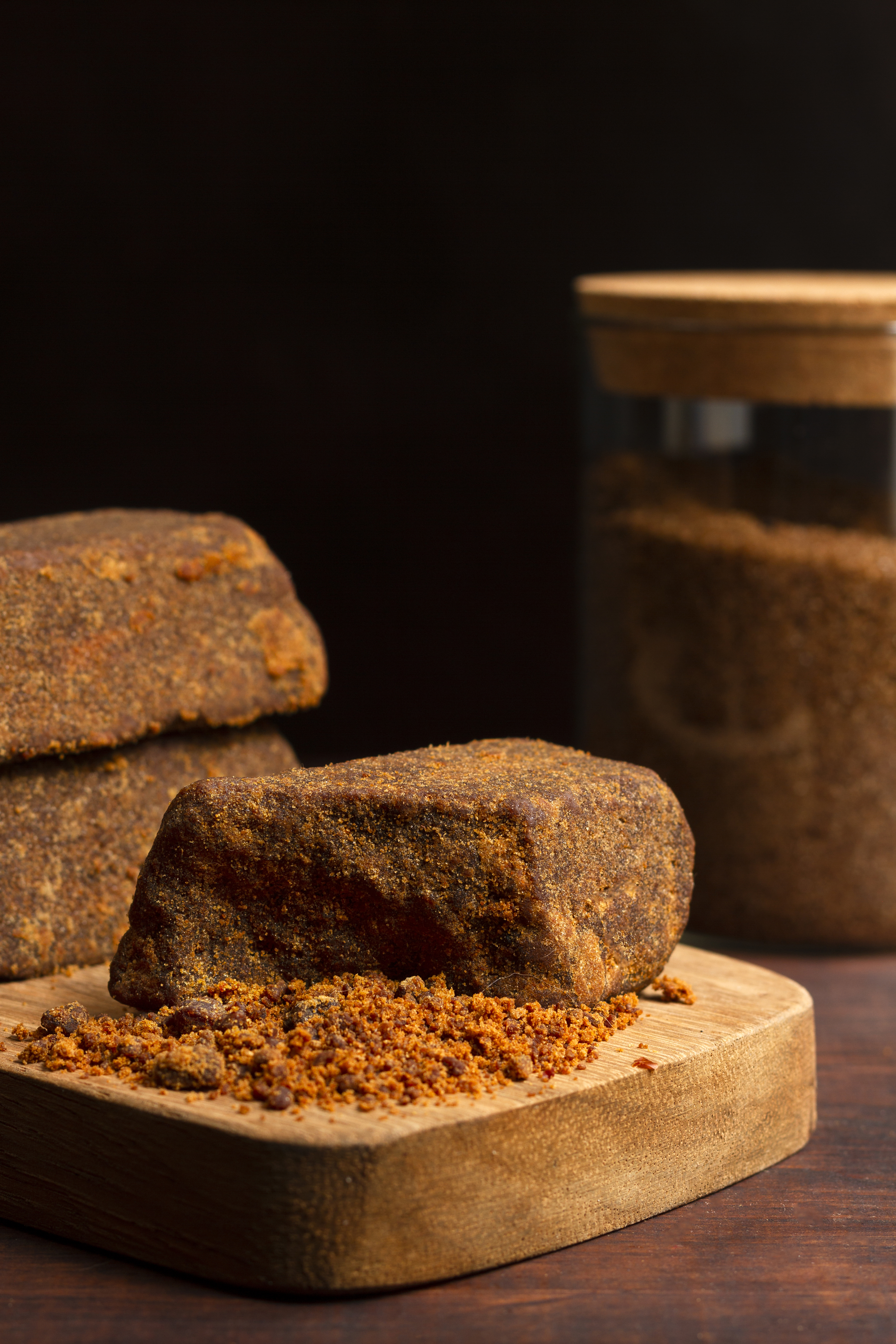
If you've spent any time sourcing natural sweeteners for the international market, you've probably come across jaggery from various origins — Tamil Nadu, Gujarat, Uttar Pradesh, Bangladesh, Pakistan. But experienced buyers consistently return to one origin: the Kolhapur-Sangli belt of Maharashtra, India. This guide explains exactly why, and what to look for when evaluating quality.
What Is Jaggery?
Jaggery (also called gur in Hindi or gul in Marathi) is an unrefined whole sugar made by concentrating fresh sugarcane juice without any chemical processing. Unlike white sugar, which is stripped of all molasses and minerals during refining, jaggery retains the full nutrient profile of the cane — iron, magnesium, potassium, calcium, and B-vitamins.
It is available in three primary commercial forms:
- Slab (block) jaggery — traditional cylindrical or flat blocks, 250g to 1kg, used in food processing and cooking
- Jaggery powder — granulated form, easier to measure and dissolve, preferred by food manufacturers and retailers
- Jaggery cubes — standardised portion sizes, popular in retail packs and premium food segments
Why the Kolhapur-Sangli Belt Is Different
1. The Sugarcane Variety
The Kolhapur-Sangli region grows primarily the Co-86032 and Co-7219 sugarcane varieties, which are known for their high sucrose content (14–16%) and low fibre ratio. Higher sucrose means more yield per tonne and a naturally sweeter, richer jaggery with deeper colour and aroma.
Contrast this with cane varieties in northern India, which tend to have lower sucrose density — producing jaggery that is lighter in colour but also thinner in taste and mineral content.
2. The Soil and Climate
The western Maharashtra plateau where Kolhapur and Sangli districts sit receives adequate rainfall from the Arabian Sea, balanced by the rain-shadow effect of the Sahyadri mountain range. This creates an ideal microclimate: the cane grows slowly, concentrating more minerals from the laterite and black cotton soils that are naturally rich in iron and potassium.
This is why Kolhapur jaggery consistently tests higher in iron content compared to samples from other origins — an attribute that matters to health food markets and nutraceutical buyers.
3. Traditional Open-Pan Processing
Unlike mechanised jaggery produced in closed vacuum pans (common in UP), Kolhapur jaggery is still predominantly made using the traditional open-pan method:
- Freshly crushed cane juice is filtered and transferred to large iron or stainless steel cauldrons
- It is boiled over firewood or bagasse (cane fibre) at temperatures between 105–115°C
- During boiling, impurities are skimmed manually — no chemicals are added for clarification
- The concentrate is poured into moulds and air-cooled to form the final blocks
This slow, artisanal process preserves the volatile aromatic compounds and micro-minerals that vacuum-pan processing destroys. The result is a jaggery with a complex caramel-molasses flavour profile that commands a premium in gourmet and health food channels.
Buyer's Note
Kolhapur jaggery does not use sulphur dioxide (SO₂) or any bleaching agents — this is a key compliance advantage for markets like the EU and UK, which have strict limits on SO₂ in natural sweeteners.
4. GI Certification
Kolhapur Jaggery holds a Geographical Indication (GI) tag from the Government of India, granted under the Geographical Indications of Goods (Registration and Protection) Act, 1999. This is the same type of legal protection enjoyed by Darjeeling Tea, Basmati Rice, and Alphonso Mango.
What this means for buyers:
- Authenticity is legally verifiable — you can cite the GI origin in your product labelling
- It differentiates your product in retail markets where origin story matters
- It signals quality assurance to food safety regulators in importing countries
Quality Parameters: What to Specify in Your Purchase Order
| Parameter | Premium Grade | Standard Grade |
|---|---|---|
| Colour | Golden yellow to dark amber | Dark brown |
| Sucrose content | ≥ 70% | 60–70% |
| Moisture | ≤ 3% | 3–5% |
| Invert sugars | ≤ 10% | 10–15% |
| Ash content | ≤ 2% | 2–4% |
| Iron content | ≥ 11 mg/100g | 7–11 mg/100g |
| SO₂ | Nil | Nil (Kolhapur standard) |
Packaging and Export Standards
For international buyers, Kolhapur jaggery is typically packed in:
- 25 kg HDPE woven bags with inner food-grade liner — standard for bulk B2B orders
- Retail packs of 500g / 1kg in vacuum-sealed pouches (for importer-branded retail distribution)
- Palletised shipments on heat-treated wooden pallets (ISPM-15 compliant) for container loading
Shelf life is 12 months from date of manufacture when stored below 25°C in a dry environment. Higher moisture content reduces shelf life — always verify moisture levels in the Certificate of Analysis (CoA) before accepting a shipment.
How Grihvaa Sources Its Jaggery
Grihvaa Private Limited sources exclusively from registered jaggery cooperatives and processing units in the Kolhapur-Sangli belt. All consignments are:
- Tested at NABL-accredited laboratories before dispatch
- Covered under FSSAI Central License (No. 11526996000533)
- Exported under APEDA RCMC certification
- Shipped with full documentation: CoA, phytosanitary certificate, Certificate of Origin, and packing list
Ready to Source?
Minimum order quantity is 1 metric tonne. We supply jaggery slab, powder, and cubes. Contact us for a quote, samples, or technical specifications.